


CGT Property Valuation in Canberra: What ACT Property Owners Need to Know
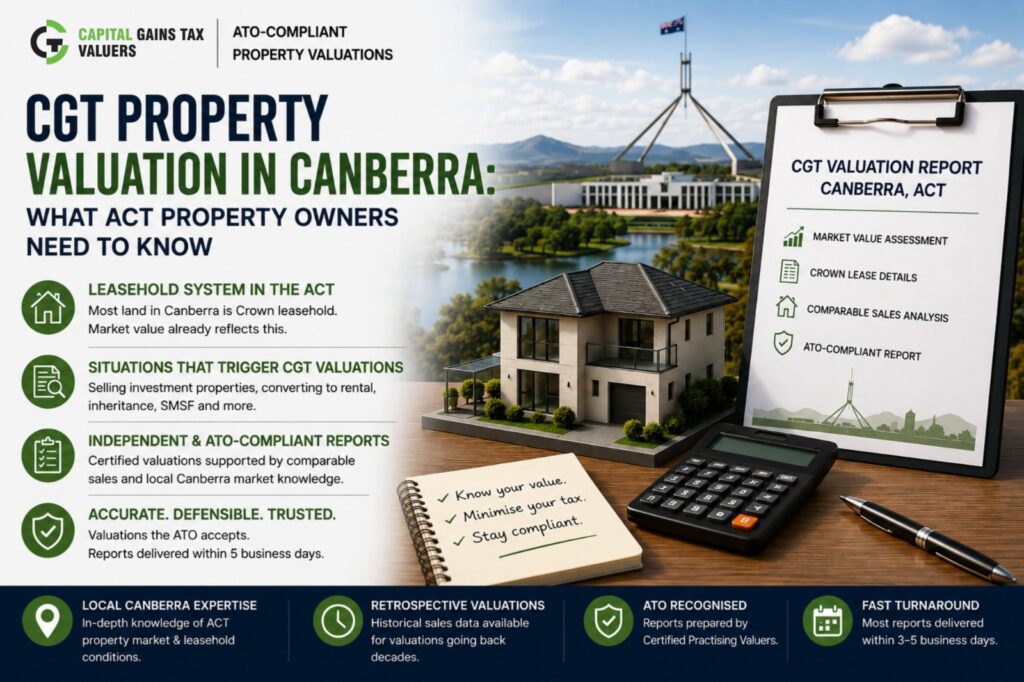
Canberra property owners face a CGT valuation process that is largely the same as the rest of Australia, with one significant difference: most land in the ACT is held under Crown leasehold rather than freehold title. This affects how properties are described, how valuers assess them, and what documentation is relevant when establishing market value for capital gains tax purposes. This guide explains how CGT valuations work in Canberra and what to expect when you need one.
How Canberra’s Leasehold System Works and Why It Matters for CGT
In most Australian states, residential land is owned outright by the property owner as freehold title. In the ACT, almost all land is owned by the Commonwealth government and leased to individuals and businesses under Crown leases. What most Canberrans own is the right to occupy and use the land under the terms of that lease, along with ownership of the building or improvements on it.
For most CGT purposes, this distinction does not significantly change how the valuation is approached. The market value of a property in Canberra is still determined by what a buyer would pay in the open market, and that price already reflects the leasehold nature of the title. The ATO treats the disposal of a Crown leasehold interest in the same way as freehold for CGT purposes.
However, there are some specific situations where the leasehold structure becomes directly relevant. Change of use applications, lease variations, and the expiry or renewal of Crown leases can all create CGT events or affect the cost base of a property, and each of these may require a separate valuation at the relevant date.
Common Situations That Trigger a CGT Valuation in Canberra
Selling an Investment Property
If you have owned a rental property in Canberra and are planning to sell, your accountant will need to establish the cost base to calculate your capital gain. If the property was purchased without a formal valuation, or if records from the time of purchase are incomplete, a retrospective valuation as at the acquisition date will be required.
Converting a Home to a Rental
Many Canberra homeowners rent out their principal place of residence when they relocate for work, particularly those in the public service who may be posted interstate. The moment the
property ceases to be your main residence and begins generating rental income, a CGT event is created. A market valuation at that date establishes the value for future CGT purposes.
Inherited Properties in Canberra
Canberra has a significant proportion of long-term homeowners, many of whom purchased property decades ago when values were much lower than they are today. When these properties pass to beneficiaries, the date of death valuation becomes the starting point for any future CGT calculation. A certified valuer can prepare this report regardless of how long ago the death occurred.
SMSF Properties in the ACT
Self-managed super funds holding property in Canberra are subject to the same ATO valuation requirements as anywhere else in Australia. Annual financial statements must reflect market value, and any related party transactions must be supported by an independent valuation at the date of transfer.
| Real Scenario |
| James purchased an investment unit in Tuggeranong in 2009 for $385,000. He rented it out for fifteen years and decided to sell in 2024. His accountant needed to confirm the original cost base and also review whether any improvements made over the years qualified as capital expenditure for the purpose of adjusting that base. Because James had not obtained a formal valuation at the time of purchase, a retrospective valuation was prepared as at the 2009 acquisition date using comparable ACT sales from that period. The report was used by his accountant to complete the CGT calculation and lodge his tax return. |
What an ACT Property Valuation Report Covers
A CGT valuation for a Canberra property follows the same professional standard as any other Australian jurisdiction. The report will include the property address and title details, the valuation date, the methodology applied, the comparable sales used to support the conclusion, and the certified market value.
For ACT properties, the valuer will also note the Crown lease details, the current permitted use of the site, and any relevant lease conditions that may affect value. This is standard practice for Canberra valuations and ensures the report properly reflects the leasehold nature of the property.
How Valuers Determine Market Value in the Canberra Property Market
Canberra has a relatively contained property market compared to Sydney and Melbourne, but it is not a uniform one. Valuers assess properties suburb by suburb, taking into account proximity to employment centres in the city, the Parliamentary Triangle, and major hospitals and
universities. The inner south and inner north continue to attract premium values, while outer suburbs such as Tuggeranong and Belconnen are assessed against their own recent comparable sales.
For retrospective valuations, the ACT has well-documented historical sales records that allow valuers to establish values going back many decades. This makes Canberra a straightforward market for retrospective CGT work.
| ATO Reference |
| The ATO treats the disposal of a Crown leasehold interest in land as a CGT event in the same way as freehold. Under the ITAA 1997, CGT applies to any capital gain made on the disposal of a CGT asset, and a leasehold interest in land is a CGT asset. The market value at the relevant date must be determined by a qualified, independent valuer to be accepted in a tax return. |
Conclusion
Canberra property owners face the same CGT obligations as property owners anywhere else in Australia. The leasehold title structure adds a layer of local knowledge to the valuation process, but it does not fundamentally change what is required. If you are selling an investment property, converting a home to a rental, managing an inherited estate, or maintaining SMSF compliance, an independent CGT valuation from a certified valuer is the correct starting point.
Need a CGT property valuation for an ACT property? We service Canberra and surrounds with ATO-compliant reports delivered within 5 business days. Request a quote at capitalgainstaxvaluers.com.au
Frequently Asked Questions
Does the ACT leasehold system affect how CGT is calculated on my property?
Not significantly for most standard residential transactions. The ATO treats leasehold and freehold disposals the same way for CGT purposes. Where the leasehold structure becomes more relevant is in situations involving lease variations, change of use applications, or lease expiry, which can create separate CGT events.
Can a valuer based in Sydney prepare a valuation for my Canberra property?
Technically yes, but in practice a valuer with specific local Canberra market knowledge will produce a more defensible report. The ACT property market has its own characteristics, and familiarity with local comparable sales and Crown lease conditions is important for accuracy.
My Canberra property was purchased in the 1990s. Can a retrospective valuation still be done?
Yes. ACT property sales records are well documented and historical market data is available going back several decades. A certified valuer can prepare a retrospective valuation for most dates since the 1980s.
I converted my Canberra home to a rental when I was posted interstate. Do I need a valuation at that date?
Yes. The date your property ceases to be your principal place of residence and begins generating rental income is a CGT event. A market valuation at that date establishes the value that will be used to calculate your capital gain when you eventually sell.
How long does a Canberra CGT valuation take and what does it cost?
Most Canberra residential CGT valuation reports are completed within three to five business days. Cost depends on property type and the complexity of the retrospective research required. You can request a fixed fee quote before committing, with no obligation.